Start your Business
- Are you thinking about starting your own business?
- Have you already identified the type of the business you want to start?
- Do you already have a feasibility study and want to get your project going fast and easy?
- Do you need to register your business?
- Do you need to obtain the required licenses and permits?
- Do you have doubts and don’t know if you need a permit or a license?
We are here to help you!
Contact Us at your earliest convenience:

About Us
 was established to assist and support entrepreneurs like you to establish your business quickly, efficiently, and in compliance with the puzzling federal and state laws and regulations.
We do know that any business must go through the process of planning and getting permits which could be somehow cumbersome, time consuming, and baffling; but you do not have to undertake it alone. Whether you are starting a new business, or expanding an existing one, has the necessary experience at your service to assist you to navigate the licensing and permitting process to avoid unnecessary delays, fees and expenses.
Types of Business
When beginning a business, you must decide what form of business entity to establish. Your form of business determines which legal and tax considerations are implied. We can help you determining what kind of business suits your business project better.
Corporation
- A corporation is an independent legal entity that exists separately from the people who own, control and manage it.
- It does not dissolve when its owners (or shareholders) die because it is considered a separate “person.”
- A corporation can enter into contracts, pay taxes, transact business, etc.
- The owners have limited liability.

Limited Liability Company
- A limited liability company (LLC) is similar to a corporation, but with slight differences.
- Like a corporation, it offers limited personal liability.
- An LLC is not required to hold regular stockholder or management meetings, and there are no requirements to comply with other corporate formalities.
Partnership
- A partnership exists when two or more persons co-own a business and share in the profits and losses of the business.
- Each of the co-owners or partners contribute something, usually money or real property, to the business endeavor.
- There are two types of Partnerships: General and Limited. Both general and limited partners benefit from the business’s profits.

General Partnership
- A partnership where the rights and responsibilities are divided equally among the partners.
- The partners are referred to as general partners because each partner can act on behalf of all the partners, and each partner is responsible for the partnership’s debts and obligations.
Limited Partnership
- This type of partnership allows each partner to determine and/or limit his or her personal liability.
- Unlike general partners, limited partners are not responsible for the partnership’s actions, debts and obligations.
- General partners have the right to manage the business. Limited partners do not.
Sole Proprietorship
- A sole proprietorship is the simplest and most common structure chosen to start a business.
- It is an unincorporated business owned and operated by one individual with no distinction between the business and the owner.
- Sole proprietorships, when not operating under the owner’s legal name, must register a fictitious name with the Division of Corporations.

Business Licenses
To start a business, you may need to apply for one or more Business Licenses to be and stay compliant with confounding government regulations. Is it a for-profit business or a nonprofit? Are you considering outside investors? Will you be providing a professional service? It can feel overwhelming. AMG Commercial Corp. will advise you on which business licenses you need in your area, and request them for you.
Permits

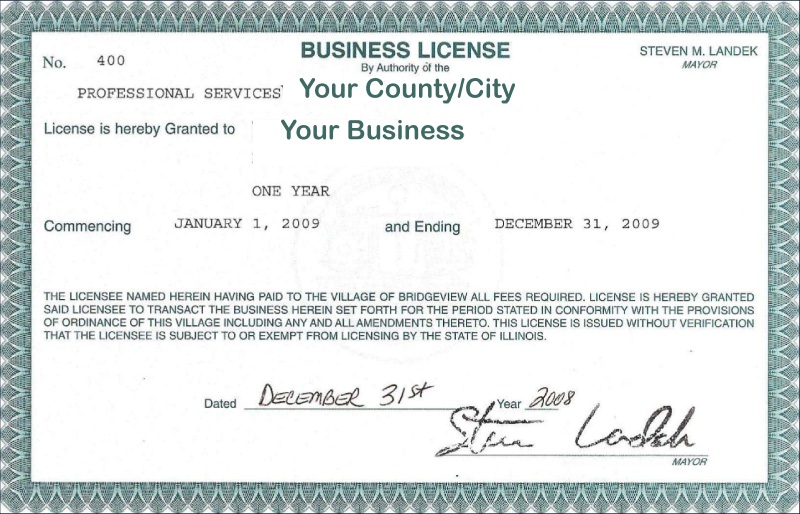
A permit is an official document authorizing the applicant to undertake certain activities. Permits are required for a variety of activities, including construction and/or demolition of a new building or structure, trades (example: Plumbing & Gas), public right-of-way, special events, pools, land disturbing activity and much more.
Building permits are required to protect the health, safety and welfare of residents. Failure to obtain the required permit is a violation of the law.
Some residential properties (example: apartment buildings with three or more dwelling units) are considered commercial per the Building Code and therefore require Commercial Building Permits. If you’re unsure, AMG Commercial Corp. will assist you in both determining whether your project is considered Residential or Commercial, and then obtaining the required permits

Project Execution Permits and Licenses
- CERTIFICATE OF USE – C.U.
- Zoning, DERM, WASD, FIRE
- CITY OR MUNICIPALITY CERTIFICATE OF USE
- ESTABLISH USE
- Building Process
- PERA – DERM
- Industrial permits IW5 – IW6
- Pretreatment
- Allocation
- Asbestos
- Air Operating Permit
- PERC Dry Cleaners Permit
- Flood Elevation Certificate (Unincorporated Miami-Dade)
- Grease Discharge Operating Permit
- Industrial Facilities – IW-O
- Industrial Facilities – IW-P
- Resource Recovery and Management Facility Solid Waste Permit
- OCCUPATIONAL LICENSE
- MUNICIPAL OCCUPATIONAL LICENSE
- STATE OF FLORIDA LICENSES
- DBPR
- ALCOHOL & TOBACCO
- HOTELS AND RESTAURANTS
- COSMETOLOGY
- Others
- DBPR
Product Commercialization
Your products and services need to be brought to markets following an organized and effective strategy to achieve commercial success. A commercialization strategy involves essential tasks including distribution, marketing, and sales. AMG Commercial Corp. will advise you in selecting the best commercialization strategy for your business.
A successful commercialization strategy requires a three-tiered approach:
- Ideation: strives to incorporate a marketing philosophy known as the four Ps, which stand for product, price, place, and promotion.
- Business process: focuses on generating products that meet consumer demands and align with the company’s business model including feasibility, costs, and how a potential commercialization strategy could actually be rolled out.
- Stakeholder engagement: involves identifying target audiences and stakeholders for the product or service. For commercialization to truly succeed, a company must satisfy both its customer and stakeholder needs.
Before a product may be brought to market, legal measures and protections must be undertaken to protect both a product’s intellectual rights, and its company’s business entitlements. Essential legal protections include permits, licenses, patents, and trademarks registrations.
Contact Us
Contact Us automatically by clicking on one of the following options:
 Contact Us through Whatsapp:
 Send Us a Phone Text Message:
 Send Us an Email to
  Call Us by phone:
 See Us In Instagram
Contact Form
Fill in the following simple form and we will get back to you promptly: